Most AI PoCs fail not because the technology is flawed, but because teams misscope. They skip proper evaluation and underestimate the difference between a demo and a real product.
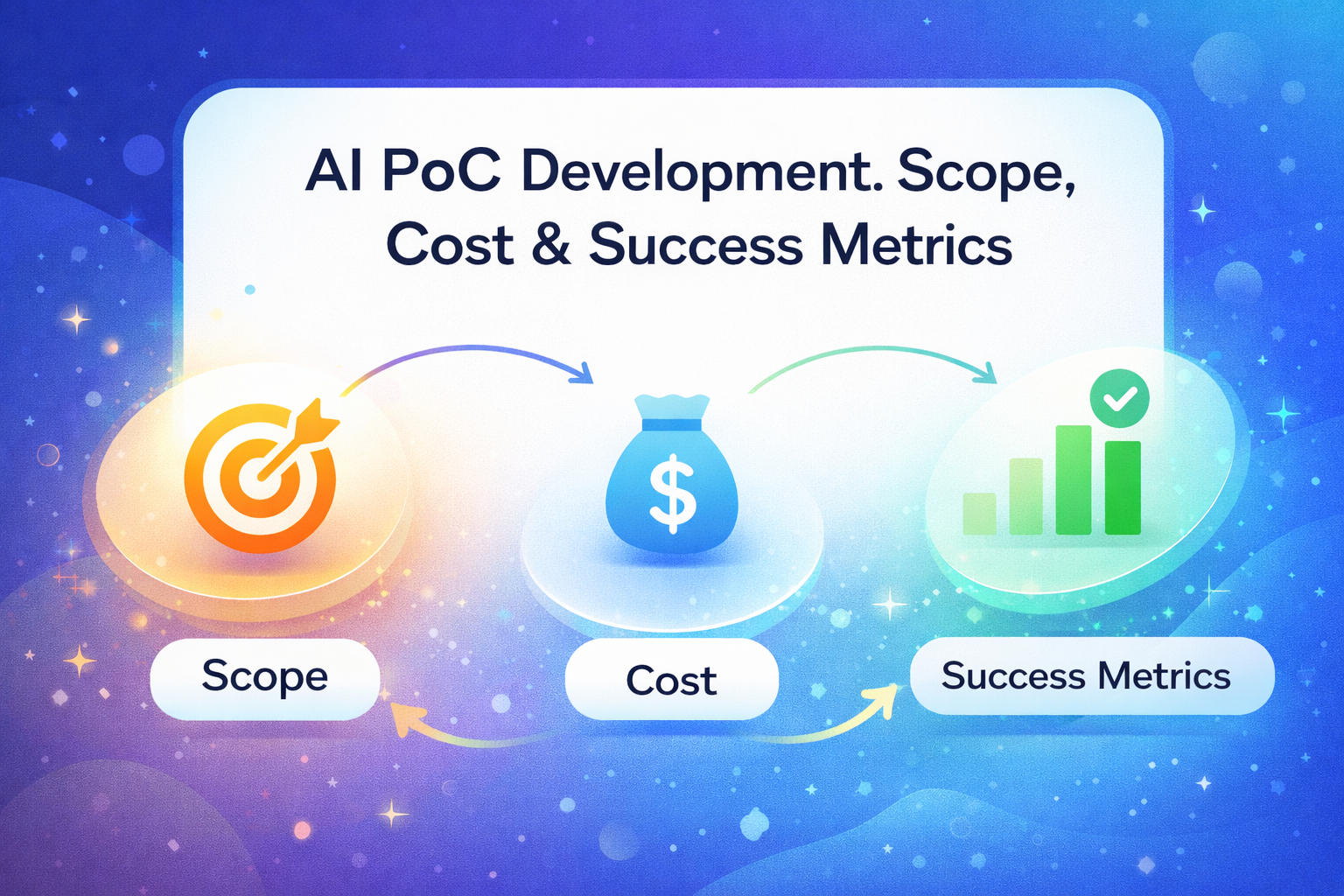

Most AI PoCs fail not because the technology is flawed, but because teams misscope. They skip proper evaluation and underestimate the difference between a demo and a real product.
The RAND Corporation says that over 80% of AI projects fail, which is twice the rate of regular IT projects. Gartner predicts that by the end of 2025, more than half of GenAI projects will be dropped after the PoC stage. Still, companies that get it right see big results:
Google Cloud found that 74% of companies using GenAI effectively achieve ROI within a year. BCG reports that companies scaling AI achieve three times the revenue impact compared to those stuck in pilot mode. This guide brings together the best 2024-2025 research from AWS, McKinsey, Gartner, Anthropic, and many practitioners into a clear plan for building a PoC that actually makes it to production.
1. Scoping: one use case, four to eight weeks, no exceptions
The most important decision in an AI PoC is deciding what not to build.
McKinsey reports that 75% of generative AI's economic value is found in just four areas:
customer operations
marketing and sales
software engineering
R&D.
These areas represent $2.6 to $4.4 trillion in annual value. Your PoC should focus on one specific problem within one of these fields.
What makes a good PoC use case?
The best choice is where high business value meets high data readiness. AWS suggests using the OGSM framework (Objectives, Goals, Strategies, Measures) to link business goals to technical results.
For example:
Objective is to improve customer support efficiency
Goal is to cut the average handle time by 30%
Strategy is to use AI-driven email summarisation
Measures are answer relevance, hallucination rate, and latency.
A strong use case has:
a clear, measurable business problem
a clean available data for testing
a human-in-the-loop process to reduce risk
enough pain in the current process to make AI improvements stand out.
HSO suggests framing each use case as a testable hypothesis:
"RAG-based answers will deliver ≥85% correct responses and reduce answer time by 30%."
The order in which you add complexity is very important.
AWS recommends:
starting with prompt engineering, which is the simplest &fastest.
only add RAG if you need to ground answers in your own documents
move to agentic AI only for complex, multi-step tasks
save fine-tuning for last.
Most PoCs should not go beyond the second step.
Experts like Chip Huyen warn against making things too complex too soon, such as:
using agentic frameworks when direct API calls are enough
choosing vector databases when keyword search would work.
Your PoC should include one clear use case, measurable success criteria set before you start, a sample dataset that represents the real thing, a simple UI for demos (e.g., Streamlit or Gradio), a way to track per-request costs, and notes on what you learn.
Do not include:
a full production UI/UX, full system integrations
rollouts to multiple departments
custom fine-tuning (unless simpler methods fail)
enterprise-level security (use synthetic or anonymised data instead)
Timelines:
The ideal PoC lasts 4 to 8 weeks.
The suggested breakdown is:
Weeks 1-2 for discovery and data prep
Weeks 3-4 for main development and prompt engineering
Weeks 5-6 for testing, evaluation, and demos
For example, a European telecom company mentioned by McKinsey built and launched a customer chatbot in just a few weeks, and after 7 weeks, it cut wait times for about 20% of contact centre requests.
Master of Code says basic PoCs can finish in 3-4 weeks for $10,000–$20,000.
2. What it actually costs to build an AI PoC in 2025
The cost of a generative AI PoC primarily depends on labour, not infrastructure. API and cloud costs are usually low during the PoC stage. The biggest expense is paying skilled engineers.
Here is a practical breakdown.
OpenAI's GPT-4o runs at $2.50 per million input tokens and $10 per million output tokens.
GPT-4o mini is an order of magnitude cheaper at $0.15/$0.60.
Anthropic's Claude 3.5 Sonnet costs $3/$15 per million tokens
Claude 3.5 Haiku offers $0.80/$4.00.
Google's Gemini 2.0 Flash is the budget leader at $0.10/$0.40 per million tokens, with a generous free tier in Google AI Studio.
For a typical PoC generating a few hundred to a few thousand queries daily, expect $50–$1,500 per month in API costs.
Cost-saving features like:
Anthropic's prompt caching (90% savings on cached reads)
batch APIs (50% discount across all major providers)
model routing (cheap models for simple tasks, expensive models for complex ones) can reduce costs by 60-80%.
Infrastructure costs for a PoC are usually low. Vector databases like ChromaDB and pgvector are free and open-source, making them great for prototyping. Pinecone has a free tier and paid plans starting at $50 per month.
Creating embeddings with OpenAI's text-embedding-3-small costs only $0.02 per million tokens.
Hosting your app in the cloud costs $50 to $300 per month.
GPU costs only become important if you do fine-tuning: an H100 costs $3 to $7 per hour on major clouds (down from $7–$11 per hour in 2023)
LoRA fine-tuning of a 7B-parameter model costs about $1,000 to $3,000 total.
For most PoCs, all non-labour infrastructure costs stay under $2,000 for the whole project.
Labour is where the money goes. A minimum viable PoC team is 2–3 people:
an AI/ML engineer ($140,000–$250,000/year salary, or $80–$200/hour freelance)
a full-stack developer ($100,000–$180,000/year)
a part-time product manager.
The tooling ecosystem is overwhelmingly free: LangChain, LlamaIndex, CrewAI, and RAGAS are all open source. Observability tools like Langfuse offer self-hosted free tiers, and Helicone provides 10,000–100,000 free requests per month.
Total cost by PoC complexity
PoC Type | Duration | Team Size | Total Cost Range |
Simple RAG (chatbot over documents) | 4-8 weeks | 2-3 people | ₹1L - ₹3L |
Fine-tuned model | 6–12 weeks | 3–4 people | ₹3L - ₹5L |
Multi-agent system | 8–14 weeks | 3–5 people | ₹5L - ₹10L |
Agentic workflow | 10–16 weeks | 4–6 people | ₹10L - ₹15 |
Hidden costs will blow your budget if ignored. The most dangerous underestimate is the token cost explosion at scale:
teams budgeting $0.05 per request routinely end up at $0.20+ in production:
conversation histories accumulate (sending 40,000+ tokens for a 100-token response)
system prompts are resent on every call, and multi-step agent workflows multiply costs by 5-10 times
Data preparation consistently consumes 30-50% of the total project cost for cleaning, formatting, chunking, and creating evaluation datasets.
IBM reports average computing costs climbed 89% between 2023 & 2025, with every executive surveyed reporting at least one cancelled GenAI initiative due to cost overruns.
Budget a 50-100% buffer over initial API cost estimates, and plan for maintenance running 15–25% of initial development cost annually.
3. Success metrics: what to measure and what "good" looks like
A lack of clear metrics is the main reason PoCs fail to reach production. Almost one-third of CIOs say they have no clear metrics for their AI PoCs, according to CIO.com. You must define success criteria before you write any code.
For interactive apps, aim for a time-to-first-token under 500ms, an output rate of at least 30 tokens per second, and total latency under 5 seconds for short queries.
Track P50, P90, P95, and P99 percentiles, since slow outliers affect real users. Measuring hallucination rates remains hard. Even the best 2025 models have rates above 15%. RAG systems with guardrails can achieve rates below 5% for specific tasks.
Track token use and cost per query from the start with tools like Helicone or LangSmith.
Quality metrics require both automated and human evaluation.
The RAGAS framework has emerged as the standard for RAG evaluation, measuring faithfulness, answer relevance, context precision, and context recall, each scored on a 0-1 scale.
Target faithfulness above 0.85 and context recall above 0.9.
DeepEval extends this with 50+ metrics covering RAG, agents, and chatbots, integrating directly into CI/CD pipelines. The practical recommendation from DeepEval's documentation is to limit yourself to no more than 5 metrics:
2-3 generic system-specific metrics plus 1-2 custom use-case-specific ones.
For human evaluation, use pointwise scoring on 0-5 Likert scales across dimensions such as coherence, fluency, groundedness, and safety.
Calibrate automated LLM-as-judge evaluators against human raters to ensure alignment.
Business metrics show if you should scale up.
Track:
task completion rate and aim for over 85%
time saved per task. The ideal is 25–50% for well-defined apps
user adoption among pilot users with over 70% means real value
customer satisfaction gains with a 10–20% CSAT boost are possible
To estimate ROI, use this formula:
(Total Benefits - Total AI Investment) / Total AI Investment × 100.
Benefits include labour and time savings, fewer errors, and more revenue.
Google Cloud found that 86% of successful GenAI users increased revenue by at least 6%, with clear returns in 90-180 days when projects are well-scoped.
Go/no-go decision framework
Evaluate across five dimensions before deciding to scale:
Dimension | Go Signal | No-Go Signal |
Business value | Clear ROI path; measurable improvement | No quantifiable benefit; misaligned with strategy |
Technical performance | Meets latency, accuracy, and hallucination thresholds | Unacceptable error rates; can't handle real data volumes |
User adoption | >70% pilot adoption; positive feedback; tasks completed without "human rescue" | Low engagement; users revert to old processes |
Scalability | Architecture handles 10× load; data pipelines are ready | Pilot shortcuts that won't extend; no MLOps foundation |
Organizational readiness | Executive sponsor secured; change management plan exists | No sponsor; cultural resistance; unclear ownership |
If the PoC met or exceeded KPIs, move to production with a phased rollout. If results are promising but gaps remain, extend the pilot and address specific issues. If no clear business value emerged, terminate and document learnings. BCG finds that only 11% of AI initiatives that stall for more than 6 months ever realise significant value.
The recommended 2025 tech stack
For orchestration, LangChain has the biggest ecosystem for general LLM apps, while LlamaIndex is best for document-heavy RAG.
For simple cases, you can skip frameworks and just use Python with direct API calls.
For vector storage, start with ChromaDB or pgvector (both free), and move to Pinecone or Qdrant for production.
For evaluation, use DeepEval (which works like pytest for CI/CD and has over 50 metrics) along with RAGAS (the standard for RAG assessment).
For observability, Langfuse has a free self-hosted option, and Helicone is the easiest proxy-based setup.
For deployment, use FastAPI for production APIs and Streamlit or Chainlit for demo interfaces.
Architecture decision framework
Choose your architecture based on the task.
If you only need the model's general knowledge and no outside data, just use prompt engineering.
If you need answers based on your own or recent documents, add RAG.
If the task requires using external tools and APIs across several steps, use an agentic tool.
If you need to coordinate across several specialised areas, consider a multi-agent system with a supervisor
Conclusion: the three things that actually matter
After reviewing hundreds of pages of research, guides, and case studies, three factors stand out as the best predictors of PoC success, more important than which model, framework, or budget you choose.
First, be strict about scoping. Focus on one use case, give it 4-8 weeks, and stick to that deadline. Successful teams treat the PoC as a test of a hypothesis, not as a product launch. Cut anything that doesn't directly test your main idea.
Second, start evaluating from day one. The main difference between a demo & a real product is the presence of a test suite. Set up automated evaluation before you try to optimise anything. Decide on clear targets for faithfulness, relevance, & latency before you write your first prompt. Teams that skip this step often end up with an impressive demo but nothing useful in production.
Third, focus on organisational alignment, not just technical details.
BCG's 10-20-70 rule is worth repeating.
70% of AI success comes from people, processes, & culture. Get an executive sponsor. Involve IT security & compliance from the start, not later. Plan how you'll move to production from day one; a PoC that can't scale is just a demo. The technology works. The real question is whether your organisation can use it.
Ready to move from reading to building?
Stop researching and start shipping.
Pick your highest-impact use case today
set a 6-week timebox
define your three success metrics before writing a single line of code.
The difference between teams that talk about AI and teams that deploy it is a decision, made now, not next quarter.
Connect with us if you have a use case and are planning an AI PoC. We will help you in building the best PoC.
 by Avantika Sonawane