Choosing a custom software development company in Dubai? Seven questions to ask, red flags to avoid, and how to score vendors before you sign.

Large IT projects run 45% over budget on average and deliver 56% less value than promised, according to a McKinsey and University of Oxford study of more than 5,400 projects. Those numbers come from big programmes, but the pattern shows up in smaller builds too. Most of the risk sits in who you hire and how the work is set up. The code is rarely the problem.
Search for a software development company in Dubai and you get agency pages, directory rankings and sponsored ads. Every one claims to be the best. None of them helps you compare. So here are seven questions to put to any custom software development company before you sign, what a good answer sounds like, and the red flags worth slowing down for.
Why the Partner Matters More Than the Price
The McKinsey study looked at projects with initial budgets above $15 million. It found that software projects carry the highest risk of overruns, and that teams often give too little attention to strategy and stakeholders while steering only by budget and schedule. Those are partner and governance problems. You can test for them before any money changes hands.
The market isn't getting quieter either. Gartner expects software spending across the Middle East and North Africa to grow 13.9% to $20.4 billion in 2026. More demand means more vendors chasing your project, which makes a structured evaluation worth far more than a quick comparison of quotes.
Where to Build Your Shortlist
If you are hunting for a custom software development company in Dubai, start with sources you can check: Google results, directories such as Clutch and GoodFirms, and recommendations from peers who have shipped similar software. The first two give you a starting list, not proof. A rating built on 30 reviews isn't the same as one built on a thousand, and a "top 10" list tells you who is listed, not who is right for you.
Peer referrals carry the most weight. Pick three or four vendors and take them through the questions below.
Seven Questions to Ask Before You Sign
1. Have you built something like this before?
Ask for two or three relevant case studies with measurable outcomes, like hours saved or errors cut. A different industry still counts if the problem was similar. Then call at least one client yourself. Red flag: portfolio screenshots with no results attached.
2. Who will actually work on my project?
A good custom software development company names the project manager, lead developer and designer upfront. It also tells you whether the people from the sales meeting stay on the job. Red flag: "the team will be assigned after signing."
3. How do you handle scope, changes and pricing?
Look for a discovery phase, a written change-request process and an estimate that covers testing, deployment and handover. Fixed-price, time-and-materials and dedicated-team models all work when the rules are clear. A paid discovery phase or a small pilot is a cheap way to see how the team behaves. A good answer walks you through the phases and what each one costs. Red flag: one number, no breakdown.
4. How do you handle UAE data protection and hosting?
Outside the financial free zones, the federal data protection law (Federal Decree-Law No. 45 of 2021) applies. DIFC and ADGM run their own regimes. Ask where data is hosted, who can access it, and how consent and cross-border transfers are handled. A good answer names the hosting region and the person responsible for data requests. Red flag: "we are fully compliant" with no specifics.
5. Can the software work in Arabic and English, and connect to our existing systems?
Right-to-left layouts, bilingual content and integrations with your ERP, accounting tool, payment gateway or WhatsApp need scoping from day one. Red flag: integrations described as "easy to add later."
6. How will we see progress?
Expect working demos every one to two weeks, a shared task board and one accountable contact. A fixed meeting rhythm beats a promise to "keep you posted." Red flag: silence until a milestone, then a surprise.
7. Who owns the code, and what happens after launch?
Your contract should say you own the source code. The vendor should also hand over documentation and offer a support agreement with response times. Red flag: licence-locked code or no post-launch plan.
How to Score Your Shortlist
Once three or four vendors have answered,
score them on one sheet. The weights below are starting points, so change them
to match your priorities. If your project involves AI, our
guide to red flags and green flags of an AI development company covers
similar ground. Two vendors with similar totals? Go back to the data protection
and team rows. Those are the hardest things to fix once the contract is signed. 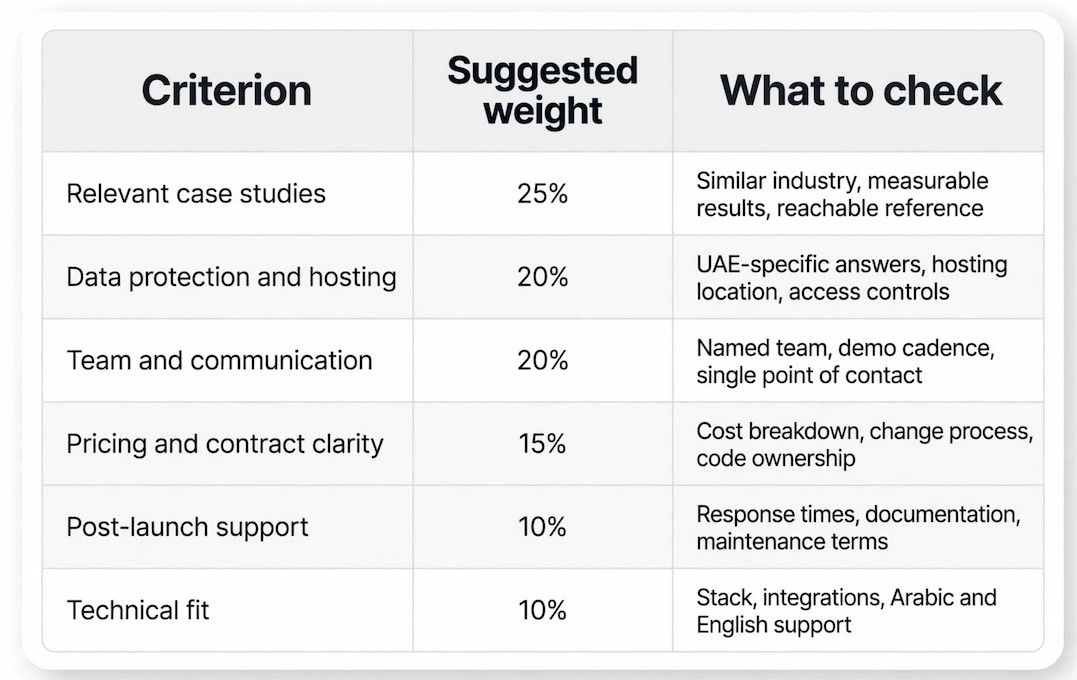
How AaiNova Approaches Custom Builds
Evidence matters, so here is ours. For Car Bike Mart, a vehicle trading platform, we built buyer-seller matching, automated lead categorisation, real-time offer management and WhatsApp automation. Manual coordination dropped by 70%. We have also built a retail ecommerce application for bakeries and florists, covering custom orders, delivery scheduling and payments.
Results like these depend on the client's own processes, so yours will differ. What carries over is the habit of defining outcomes before the build starts. You can read more about our custom application development services.
Final Thoughts
The right custom software development company in Dubai can show relevant results, name its team, put prices and ownership in writing, and answer UAE-specific questions without hand-waving. Use the seven questions. Score every vendor on the same sheet. And be willing to walk away from the one that can't answer plainly. Ask plainly, score fairly, decide on evidence.
Looking for a Custom Software Partner in Dubai?
If you're comparing vendors or scoping a first build, talk to AaiNova's experts. We'll review your requirements, show you how we would answer these seven questions for your project, and suggest what to build first.

 by Avantika Sonawane