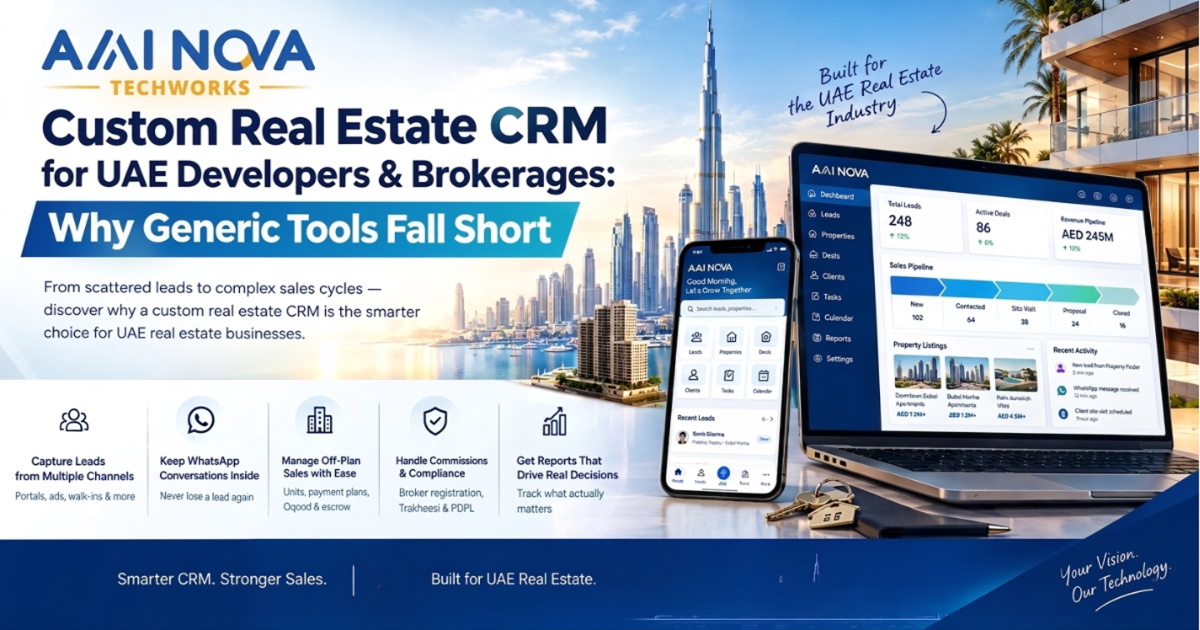
Leads land on WhatsApp, three different portals, and a few stray spreadsheets, but rarely in the CRM itself. This blog post looks at why generic tools struggle with UAE property sales, what a custom real estate CRM actually includes, and how developers and brokerages can tell if building one is worth it.
Ask a Dubai sales manager where their leads live, and the honest answer is rarely “in the CRM.” Some are sitting in Property Finder and Bayut enquiry emails. Plenty are in WhatsApp chats on an agent’s personal phone. A few are in a spreadsheet someone started in 2022, and nobody wants to delete.
That’s why so many property firms in the UAE buy a real estate CRM and still don’t trust the numbers it shows them. The tool isn’t always bad. It just wasn’t built around how property actually gets sold here. This post looks at where generic CRMs break down, what a custom one includes, and how to work out whether building your own CRM for real estate is worth it.
Where Generic CRMs Start to Break
1. Leads arrive from everywhere at once
Most computerized retail management systems assume that a potential client comes in after completing an online form or signing up for an email marketing campaign. However, inquiries in the UAE real estate market come from different brokers, listing portals, Meta advertisements, roadshows, walk-ins at the sales gallery, and sometimes within the same hour. Duplicates build up because the same buyer frequently visits three separate portals. Two agents will ultimately pursue the same person while a legitimate inquiry remains unanswered if regulations are not put in place to handle this circumstance.
2. WhatsApp exists outside the system
For many buyers in this situation, WhatsApp is the first conversation, not the follow-up. Once those chat conversations remain on individual phones, the company loses the conversation history whenever an agent leaves. Although some off-the-shelf tools provide WhatsApp integration, this feature is usually available only as a paid extra and comes with its own restrictions regarding what is recorded.
3. Off-plan sales have their own logic.nstead of dealing with a single property, a developer deals with hundreds of units dispersed across different towers and phases, each of which has a status, a price, a payment schedule, and sometimes a reservation period. In Dubai, the process also involves Oqood registration and escrow-linked payments. Buyers pay in installments based on building milestones. While generic CRMs are good at tracking sales, they rarely keep track of inventory and related payment dates. As a result, teams must use spreadsheets to fill in the gaps.
4. Commissions and compliance don’t fit a template
The division of commissions among developers, brokerages, and individual agents becomes very complicated quickly. There is information about broker registration, advertising permits like Trakheesi, and the data protection regulations outlined in the UAE's PDPL. If a CRM system cannot limit who can read buyer data or provide a permit number to a listing, then all the verification has to be left to people, and people tend to forget.
5 . Reporting that answers the wrong questions
Managers usually want to know which portal produces actual buyers, not just enquiries; how long agents take to respond, and which project has inventory that’s quietly stuck. Standard dashboards mostly report activity. Getting real answers often means exporting data and building the report by hand every month.
What a Custom Real Estate CRM Actually Includes
The feature list depends on who’s using it, so it helps to split things by role.
For developers
• Unit inventory by project, tower, floor, and status, updated live as units are held, booked, or sold
• Payment plan and milestone tracking linked to each buyer
• Broker and channel partner portals, so outside agents can check availability and submit leads without calling your office
• Approval workflows for discounts and special offers
For brokerages
• Automatic lead capture from portals, ads, and WhatsApp, with duplicate checks
• Assignment rules based on area, language, or agent availability
• Listing and viewing management, including permit details
• Commission calculation and agent-level performance reports
For both
• Arabic and English interfaces, with right-to-left support where it’s needed
• Dashboards that run on live data instead of month-end spreadsheets
• Connections to accounting or ERP systems, and role-based access so people only see what they should
AI is starting to earn a place here too, mostly in unglamorous ways: scoring leads by how likely they are to convert, drafting follow-up messages, flagging deals that have gone quiet. It’s worth adding once the basics work, not before.
What AaiNova Brings to a Real Estate CRM Build
A real estate CRM needs a number of features that AaiNova has already developed in other fields. The team decreased manual coordination by 70% for Car Bike Mart, a car trading site, by integrating buyer-seller matching, automated lead categorization, real-time offer management, and WhatsApp automation. When you exchange cars for condos, the scenario is the same.
A cloud platform that delivers analytics, inventory monitoring, and multi-role access decreased manual record-keeping in the cattle management industry by 40%.AaiNova has also delivered a custom eCommerce application for a Dubai bakery and florist, covering delivery scheduling and payment integration, so working within UAE requirements isn’t new territory. Those results come from different industries, of course, and yours will depend on your own processes. The point is that the building blocks are proven.
Custom vs Off-the-Shelf: How to Decide
Custom isn’t automatically the right call. A ready-made CRM is usually enough when:
• You’re a small brokerage with a handful of agents
• Your process is fairly standard: leads in, viewings, deals closed
• You need something running in weeks rather than months
Custom starts to pay off when:
• You’re a developer managing inventory and payment plans across several projects
• Agents keep working around the CRM with spreadsheets and personal WhatsApp chats
• Portals, accounting and internal approvals all need to talk to each other
• Per-user licence fees are climbing as the team grows
Cost deserves an honest look too. A subscription seems cheaper at first. Then come the extra licences, the paid add-ons, the consultant who configures it, and the hours lost every week to workarounds. The better question isn’t “Is custom more expensive?” but “What is our current setup costing us?”
Here’s a simple test. Count the workarounds. If your team keeps a spreadsheet open next to the CRM, the CRM isn’t doing its job. For a deeper comparison, read our guide on Custom Software vs Off-the-Shelf: Which Is Right for Your Business?
Five Things to Get Right Before You Build
Map the real process first. The workflow on paper and the one your agents actually follow are rarely the same. Sit with a few of them for a day before anything gets designed.
Start with a smaller scope. Launch with leads, inventory, and follow-ups, then add commissions and reporting once people are using it. AaiNova’s guide to AI Software Engagement Models: How to Choose the Right One is useful for deciding how to phase the work.
Plan the data migration early. Old spreadsheets are full of duplicates and half-filled records. Clean them before moving them, or you’ll just carry the mess into a shinier system.
Ask who owns the data and where it’s hosted. With buyer information involved, this needs a clear answer in writing before development starts.
Get agents on board. The best CRM fails if nobody logs anything. Make it easier to record a conversation than to skip it, for example by capturing WhatsApp activity automatically.
Final Thoughts
A CRM should make a sales team faster, not hand them one more thing to update. In UAE real estate, where deals move between portals, WhatsApp, and site visits, the software has to follow how people already work. For some firms, an off-the-shelf tool gets there. For developers with complex inventory and brokerages with growing teams, a custom real estate CRM often does it better.
Planning a Custom Real Estate CRM for Your Business?
If your team is juggling portals, spreadsheets, and WhatsApp chats, it may be time to rethink the setup. Talk to AaiNova’s experts about your requirements, and we’ll help you work out whether custom is the right fit and what to build first.

 by Avantika Sonawane