The $14 billion opportunity reshaping the commerce industry

AI is no longer a retail experiment. It is the operating system for getting a competitive advantage. The global AI in retail market hit $14.5 billion in 2025 and is racing toward $40-105 billion by the end of 2030. The industry is growing at 23-32% CAGR, depending on the scope.
A recent AI in Retail survey found 89% of retail and CPG companies are either actively deploying AI or assessing projects in 2026. The returns are real:
87% of respondents report revenue increases
94% cite operational cost reductions.
Yet the picture has nuance. Only 25% of AI initiatives have delivered expected ROI over the past 2 years, making a clear distinction between winners and experimenters.
For senior leaders, the question is no longer whether to adopt AI but where to deploy it for maximum impact.
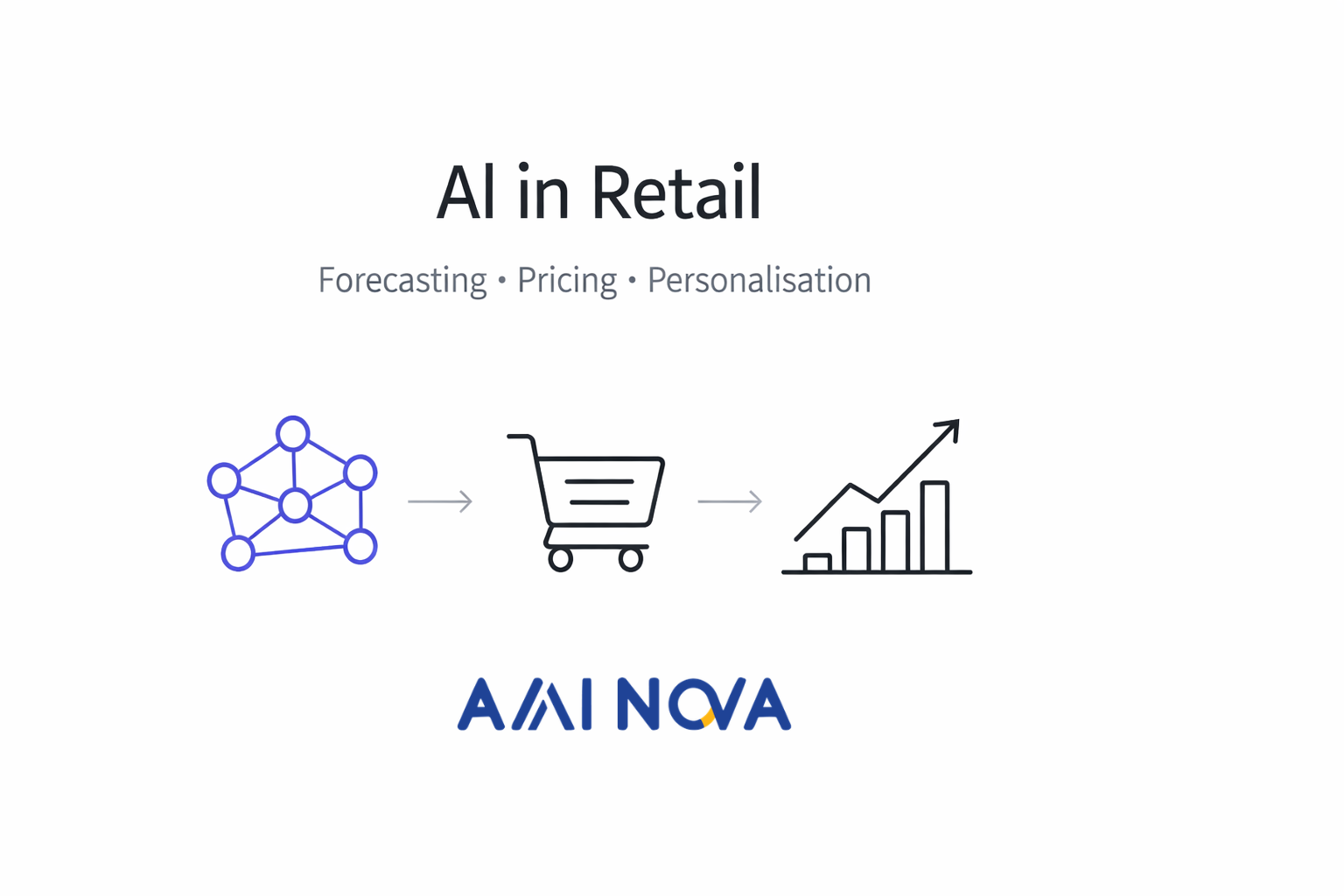
Three domains:
demand forecasting
dynamic pricing
Personalisation
represent the highest-leverage applications, each backed by measurable results from the world's most sophisticated retailers.
Forecasting accuracy: from guesswork to near-science
Traditional demand forecasting relied on historical averages, seasonal changes, and spreadsheet-bound data. AI models represent an entirely different universe of signals. Some of them are:
weather patterns
social media sentiment
local events
browsing behaviour
macroeconomic indicators
learn continuously at SKU level granularity.
AI-driven forecasting has reduced supply chain errors by 20–50% and boosted efficiency by 65% by reducing lost sales.
Walmart built a multi-horizon recurrent neural network entirely in-house that processes everything from online search trends to supplier manufacturing delays. During Hurricane Ian in 2022, when a distribution centre went offline for seven days, AI rerouted shipments in real time and met demand without customer-noticeable disruption. The result across normal operations: 15% fewer out-of-stocks during peak periods.
Amazon takes a different approach with anticipatory shipping. They moved products to geographical areas before customers' orders, using partially addressed labels that allow mid-transit rerouting. In Q1 2024, Amazon delivered over 2 billion items same-day or next-day, with 60% of Prime orders in top metro areas arriving within 24 hours.
Zara's model is perhaps the most instructive for fashion and fast-turn retail. By combining RFID tracking on every garment with AI that analyses real-time purchasing patterns and social media trends, Zara compresses the design-to-shelf turnaround to as little as one week, versus the industry average of 3 to 6 months.
The process is as follows:
New designs launch in batches of just 5,000 units
AI determines within days whether to scale production or pull the line
The payoff:
85% of Zara's inventory sells at full price
Dynamic pricing generates extraordinary gains
AI-driven pricing goes far beyond simple competitor-matching. Modern systems model demand:
elasticity in real time
incorporating inventory levels
time-of-day patterns
cross-category substitution effects
weather to optimise price points continuously.
AI-based pricing delivers revenue increases of 3–5% alongside cost reductions of 15–20%.
Amazon remains the benchmark. Its algorithms execute approximately 2.5 million price changes per day, reviewing and adjusting prices as frequently as every ten minutes. 83% of Amazon sales occur through the Buy Box, making real-time pricing a survival requirement for marketplace sellers.
But the most compelling case studies come from traditional retail. Competera, an AI pricing platform, helped a Fortune 500 department store with over 1,000 locations achieve a 40.1% increase in online revenue through AI-powered pricing optimisation.
The critical caveat for leaders: 61% of retailers have adopted some form of dynamic pricing, but most still rely on rules-based systems rather than true machine learning.
The margin advantage belongs to those who move to genuinely autonomous, AI-driven systems with proper guardrails:
price floors
maximum change thresholds
brand-protection
constraints that prevent perception problems from sinking early experiments, like Amazon's 2000 DVD pricing controversy.
Personalisation is where AI compounds value
If forecasting and pricing optimise supply-side economics, personalisation transforms the demand side.
The numbers are staggering: 35% of Amazon's revenue, which is roughly $70 billion annually, comes from its recommendation engine. Companies excelling at personalisation:
reduce customer acquisition costs by up to 50%
lift revenues by 5-15%
increase marketing ROI by 10-30%
Shoppers who engage with personalised recommendations are 4.5 times more likely to purchase, with a 369% increase in average order value.
The pattern is clear: personalisation creates a flywheel where better data drives better recommendations, which drive deeper engagement, which generates better data.
The gap between AI ambition & execution remains wide
Despite the compelling ROI data, only a few had successfully implemented generative AI across their organisations. However, 90% had begun experimenting. The barriers are structural, not strategic.
Data quality and fragmentation top the list: 76% of enterprises cite data quality and privacy concerns as their primary AI challenge, with siloed customer, product, and inventory data across channels creating foundational problems that no algorithm can overcome
Integration complexity affects 85% of retailers attempting AI deployment, as legacy ERP, merchandising, and supply chain platforms resist modern AI architectures. Companies with strong integration achieve 10.3 times the ROI from AI initiatives compared to those with poor connectivity
Talent scarcity constrains 72% of retail organisations, with an estimated 50% gap in AI talent availability.
Agentic commerce will redefine the next decade of retail
The frontier is shifting from AI that assists decisions to AI that executes them. Agentic commerce can autonomously research, compare, negotiate, and purchase on behalf of consumers.
Conclusion
The data points to a clear strategic imperative: AI in retail has crossed from experimentation to competitive necessity, with forecasting, pricing, and personalisation delivering measurable, compounding returns for organisations that commit to execution.
The differentiator is not technology selection but operational integration. Redesigning workflows, investing in data foundations, and building the organisational muscle to scale from pilot to production.
Leaders who treat AI as a bolt-on tool will join those whose pilots never reach scale.
Those who rewire their organisations around AI-native processes will capture disproportionate value in a market.
Take the Next Step
If you’re evaluating AI seriously in 2026, the best place to start is with clarity and not tools.
📅 Book a 30-minute AI Audit and discover how we can:
Assess your current platform
Identify high-impact AI opportunities
Transform your system into an enterprise-grade AI solution
No hype. No guesswork. Just a clear, practical roadmap forward.
 by Avantika Sonawane