Explore custom software development vs off-the-shelf software and compare scalability, flexibility, integrations, and long-term business value.
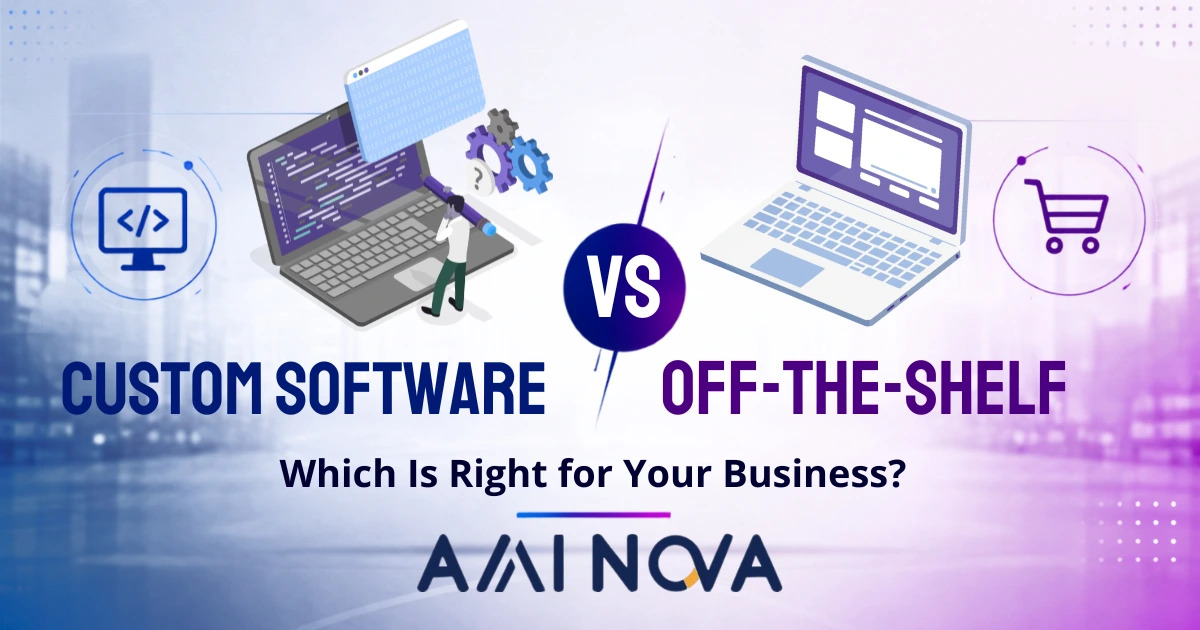

Choosing the right software can have a direct impact on how effectively your business operates, how rapidly it can scale, and how effectively it can respond to changing customer expectations. While off-the-shelf software offers a quick and instant solution, Custom Software Development gives businesses the flexibility to build technology around their specific processes and goals.
The right choice depends on your business requirements, budget, Future-proofing needs, integration requirements, and long-term strategy. In this guide, we compare custom software with off-the-shelf solutions and break down which approach makes sense.
What Is Custom Software Development?
Custom software is designed and developed specifically for a business, industry, or particular operational requirement. Instead of changing your processes to match a software product, the software is built around your existing system and future objectives.
For example, a manufacturing company may require a platform that connects production planning, inventory, quality control, distributor management, and financial reporting. A generic application may cover some of these functions, but a custom solution can bring them together in one connected ecosystem.
This approach also allows businesses to integrate technologies such as AI, analytics, cloud infrastructure, APIs, MVPs, automation, and role-based access control according to their specific needs.
What Is Off-the-Shelf Software?
Off-the-shelf software is a ready-made product designed to serve a broad market. Examples include general CRM, accounting, project management, HR, communication, and workplace management systems.
The biggest advantage is speed. Businesses can usually subscribe, install basic settings, and start using the software without going through a complete development cycle.
However, the same standardization that makes these products affordable and fast to deploy can become a limitation when your business processes become more complicated.
Custom Software Develpment vs Off-the-Shelf: At a Glance
Factor | Custom Software Develpment | Off-the-Shelf Software |
Customization | Built around your requirements | Limited to available features |
Initial investment | Usually higher | Usually lower |
Deployment | Requires development | Faster implementation |
Scalability | Designed for business growth | Depends on vendor capabilities |
Integrations | Highly flexible | Depends on available integrations |
Ownership & control | Greater control | Vendor-dependent |
Updates | Business-specific | Vendor-controlled |
Competitive differentiation | High | Limited |
Neither option is automatically better. The key question is: Which platform meets your business needs today and adapts to where you're heading tomorrow?
When Should You Choose Off-the-Shelf Software?
Off-the-shelf software can be the right choice when your requirements are straightforward and already well-supported by existing products.
You may benefit from a ready-made solution if:
You need to launch quickly.
Your business processes are relatively standard.
Your budget is limited.
You don't require extensive customization.
The software provides the integrations you need.
Regular vendor updates and support are important to you.
Limitations of Off-the-Shelf Software
Limited Customization: You must work within the software's available features.
Unnecessary Costs: You may pay for features you don't need.
Integration Issues: Connecting with existing systems can be difficult.
Scaling Costs: More users and features can mean higher subscription costs.
Vendor Dependency: Updates and features depend on the vendor.
Less Differentiation: Generic software makes it harder to build unique business capabilities.
Custom Software Development solves these limitations by providing greater flexibility, control, scalability, and business-specific functionality.
What Makes Custom Software the Superior Choice?
Custom Software Development becomes more valuable when your software needs are closely connected to your competitive advantage or operational efficiency.
Consider custom development when:
1. Your Business Has Unique Workflows
If your system doesn't fit standard software, employees may end up using spreadsheets, emails, WhatsApp messages, and multiple disconnected tools.
Custom software development can bring these workflows into a single platform.
2. You want to scale your business
As companies grow, their technology requirements adapt. More users, locations, transactions, integrations, and data can put burden on existing systems.
Custom software can be engineered with future flexibility in mind, making it easier to add modules, users, automation, and integrations.
3. You Need Multiple Systems to Work Together
A custom platform can connect systems like ERP, CRM, payment platforms, inventory systems, analytical tools, and third-party APIs, to create a more unified flow of information.
4. Software Is Part of Your Competitive Advantage
If your software directly influences how you sell, serve customers, manage operations, or deliver your product, generic technology may not provide enough differentiation.
Custom software can turn a unique business process into a technology-driven advantage.
5. You Need Greater Control Over Data and Security
Organisations operating in sectors such as BFSI, healthcare, manufacturing, and enterprise services often have defined security, access, compliance, and reporting requirements.
A custom solution allows these requirements to be considered during framework and development rather than being included as an add-on.
A Real-World Example from AaiNova
AaiNova's work with Shanthi Farm & Agri Products demonstrates why tailored software can be valuable when generic tools don't match operational requirements.
The company needed to digitize livestock and poultry operations, including animal tracking, production monitoring, inventory, supply chain coordination, analytics, and role-based access. AaiNova developed a cloud-based livestock management platform tailored to these workflows.
The implementation resulted in a 40% reduction in manual record-keeping, along with better production visibility and faster operational decision-making.
This is the practical value of custom technology: solving a specific business problem rather than simply providing another software tool.
You can explore the full Livestock Management Software Case Study to understand the approach and results.
How to Make the Right Decision
Before choosing between custom and off-the-shelf software, ask these five questions:
Are our business processes standard or unique?
Will our software requirements change significantly as we grow?
Do we need integrations that existing products cannot provide?
Is the software strategically important to our business?
What will the total cost of ownership look like over three to five years?
If most answers point toward unique requirements with AI capabilties, scalability, integration, and strategic importance, custom development may be the stronger choice.
For businesses evaluating their technology roadmap, AaiNova provides Application Development and Maintenance (ADMS) and Enterprise Application Services to help design, develop, integrate, and maintain scalable software solutions.
You can also explore AaiNova's related insights in Custom Mobile Application Development Vs Ready-Made Apps
Final Thoughts
The choice between custom software development and off-the-shelf software should not be based solely on development cost or implementation speed. It should be based on how well the technology supports your business strategy.
Off-the-shelf software is ideal when your needs are common, your timeline is short, and existing tools already solve your problems effectively.
Custom Software Development becomes a stronger version when your workflows are unique, automated, your business is scaling, integrations are critical, or technology itself is part of your competitive advantage.
Ultimately, the best software is not the one with the most features. It is the one that solves the right problems, fits your business, and continues to create value as your organization grows.
Have a unique business challenge that existing software can’t solve? Book a 30-minute software audit, and AaiNova will help you identify technology gaps, recommend the right solution, and build a flexible, secure, scalable, and AI-powered software solution tailored to your business needs.
 by Amruta Gharge