Discover how AI automation for logistics is transforming operations in 2026 through intelligent routing, analytics, automation, and AI-driven decision-making.
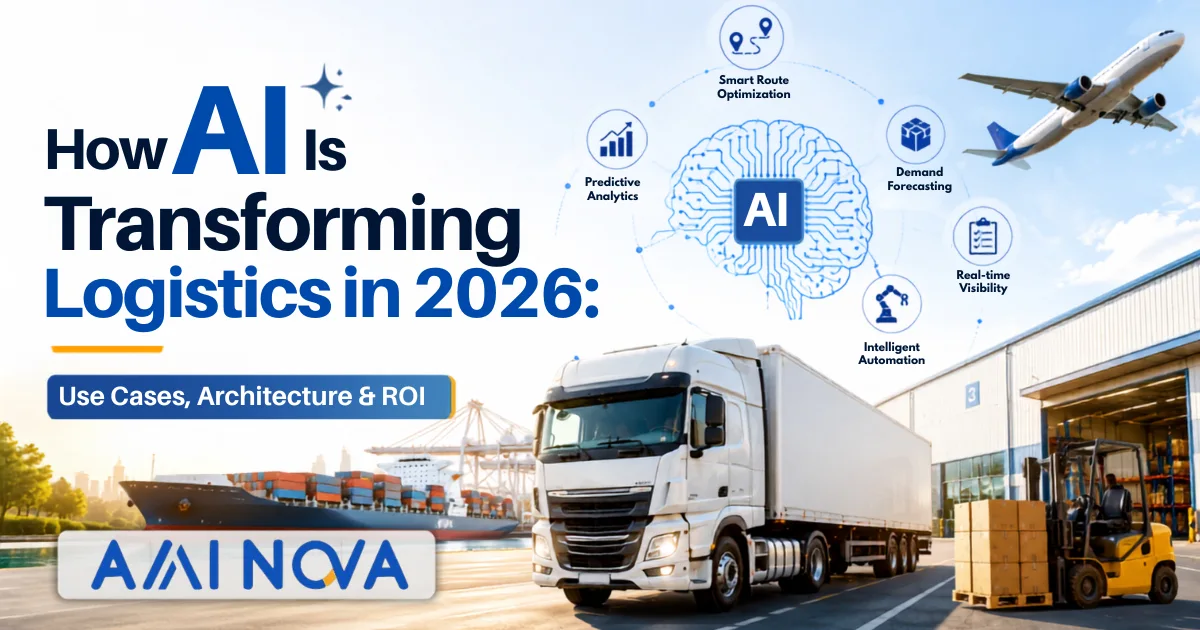

Between rising costs and high customer expectations, logistics teams are constantly pushed to move faster without compromising visibility or service quality. In 2026, artificial intelligence is becoming one of the most crucial technologies for addressing these challenges.
From intelligent route planning and maintenance to automated documentation and real-time demand forecasting, AI automation for logistics is helping companies move from reactive operations to rational, data-driven decision-making.
A study examining technology adoption among logistics and supply-chain companies in India reported that 69.7% of surveyed companies had adopted AI, making it the most prevalent technology among those studied.
Why AI Matters in Logistics in 2026
Traditional logistics operations depend on multiple systems, including Transportation Management Systems, Warehouse Management Systems, ERP platforms, GPS systems, customer portals and communication tools.
AI can bring information from these systems together, forecast patterns, predict disruptions and recommend or execute actions. This makes logistics operations more responsive and less dependent on manual work and coordination.
According to Deloitte’s 2026 State of AI in the Enterprise India insights, 48% of Indian enterprises have deployed AI at scale in supply chain functions, while 40% of Indian respondents report significant or full AI usage across their organizations, compared with approximately 28% globally.
Key Use Cases of AI Automation for Logistics
1. Intelligent Route Optimization
AI can analyse traffic, delivery locations, vehicle capacity, weather conditions, fuel consumption and historical delivery data to recommend more efficient routes.
Instead of relying on fixed routes, logistics companies can adaptively adjust transportation plans based on changing conditions. The result can be fewer unnecessary kilo-meters, improved vehicle utilization, lower fuel consumption and more predictable delivery times.
2. Demand Forecasting and Inventory Optimization
AI models can analyse historical orders, periodical patterns, market trends, customer behaviour and other business signals to forecast future demand.
This allows logistics teams to position inventory more efficiently, improves procurement and restocking decisions.
3. Predictive Maintenance
Vehicle and equipment breakdowns can cause delays in delivery, higher repair costs and operational interruptions.
AI-powered predictive maintenance analyses data from vehicles, sensors and maintenance records to identify potential failures before they become major problems. Instead of following regular maintenance schedules, companies can move toward conditional maintenance.
4. Warehouse Automation
AI can optimize warehouse operations by analysing inventory flow, order patterns, storage locations and resource availability. It can help determine where products should be stored, which orders should be prioritized and how warehouse resources should be allocated.
Integrated with robotics and computer vision, AI can support automated picking, sorting, inspection and end-to-end inventory traceability.
5. Intelligent Document Processing
Logistics generates a vital amount of documentation, including invoices, purchase orders, waybills, customs documents and proof-of-delivery records.
AI-powered document processing can extract information from documents, validate data and transfer it into business systems automatically. This reduces manual data entry and can substantially improve processing speed and accuracy.
6. Real-Time Shipment Visibility
AI can combine GPS data, shipment information, traffic conditions and historical patterns to forecast delivery delays and estimated arrival times.
Instead of simply showing where a shipment is, intelligent logistics ecosystems can explain what's coming down the pipeline. This enables logistics teams to take corrective action before a delay affects the customer.
What Does an AI Architecture for Logistics Look Like?
A successful AI deployment requires more than simply adding an AI model to an existing application.
A typical logistics AI architecture can include five layers:
1. Data Sources
ERP, TMS, Warehouse Management System, GPS sensors, warehouse systems, CRM platforms and external data sources provide the operational data.
2. Data & Integration Layer
APIs, ETL/ELT pipelines, data lakes and warehouses collect and standardize information from different systems.
3. AI & Analytics Layer
Machine learning models, predictive analytics, computer vision, generative AI and AI agents process the data and generate insights or recommendations.
4. Automation & Orchestration Layer
AI outputs can trigger workflows such as route changes, alerts, inventory actions, customer notifications or maintenance requests.
Measuring the ROI of AI in Logistics
The business case for AI Automation for logistics should go beyond technology adoption. Logistics companies need measurable KPIs.
Common ROI metrics include:
Cost per shipment
Fuel consumption
Delivery time
Vehicle utilization
Warehouse productivity
Inventory carrying costs
Manual hours saved
Error and exception rates
For example, reducing empty vehicle kilo-meters can reduce fuel expenses, while better demand forecasting can reduce excess inventory. Automating documentation can reduce employee hours spent on repetitive administrative work.
AaiNova's own experience demonstrates how targeted AI and analytics can generate measurable business results. Our AI automation approach highlights that organizations can achieve faster returns by focusing on high-volume, repetitive processes and measuring results from the beginning.
You can explore AaiNova's approach in its guide on AI automation services that deliver ROI in 60 days.
AI-Powered Logistics Technology
AI becomes particularly valuable when it is integrated into a larger digital ecosystem.
AaiNova's Vehicle Trading Platform Development for Car Bike Mart demonstrates this approach in the Travel, Transport & Logistics sector.
The platform combined AI-powered vehicle ranking, buyer-seller matching, automated lead categorization, real-time offer management, VAHAN integration, WhatsApp automation and analytics.
The implementation resulted in a 70% reduction in manual coordination, demonstrating how intelligent automation can create measurable operational improvements.
Building the Right AI Strategy for Logistics
AI adoption should start with a business problem, not with a technology trend.
Companies should first identify processes with high transaction volumes, repetitive manual work, significant operational costs or frequent decision-making requirements. From there, businesses can select a focused AI use case, integrate the required data sources, build a proof of concept, measure performance and scale the solution gradually.
AaiNova's AI as a Service offering supports businesses with production-ready AI models, API integration, domain-specific AI solutions and scalable cloud architecture.
For organizations dealing with large volumes of operational data, Digital & Data Analytics Solutions can help build the data pipelines, predictive models, dashboards and analytics infrastructure required for intelligent decision-making.
The Future of AI in Logistics
The next phase of logistics automation will move beyond prediction toward AI systems that can analyse, coordinate and act.
AI agents could monitor shipments, identify patterns, communicate with stakeholders, recommend alternative routes and trigger workflows with minimal human intervention. However, fully autonomous logistics should not be the immediate goal for every organization. Data quality, system integration, cybersecurity, governance and human oversight remain essential.
AI automation for logistics can help organizations reduce shortfalls, improve visibility, optimize resources and make faster decisions. With the right architecture, measurable KPIs and a focused implementation strategy, AI can become a practical foundation for building faster, smarter and more resilient logistics operations.
Ready to transform your logistics operations with AI? Book an AI Audit with AaiNova and discover high-impact opportunities to automate, optimize, and maximize ROI.
 by Vaibhav Narale