Explore AI and software engagement models, compare their benefits, and learn how to choose the right model for your project's goals, budget, and needs.
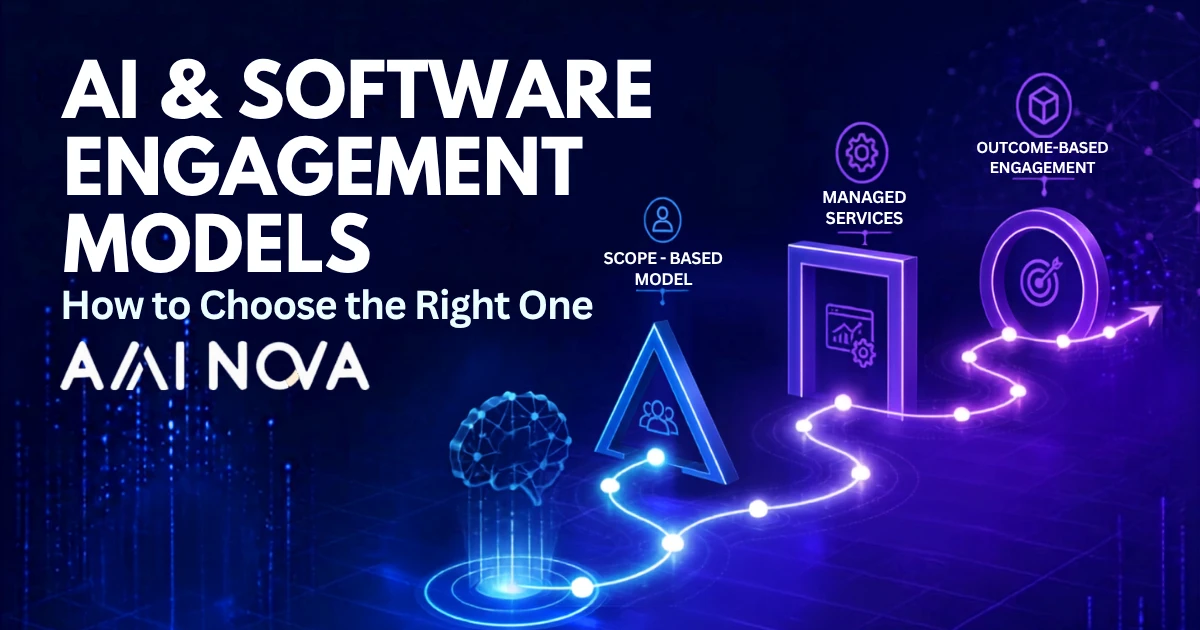

In today’s digital world, choosing the right engagement model can be just as important as choosing the right technology partner. Whether you are building an AI solution, mobile application, enterprise software or cloud solution, the way you work with your technology partner can directly impact your budget, flexibility, timelines, and business outcomes.
For businesses investing in AI and software development, there is no single model that fits every project. A clearly specified application may benefit from a structured, scope-based approach, while an AI initiative that evolves through experimentation may require greater flexibility.
Why Engagement Models Matter for AI & Software Projects
A company developing a simple mobile application may know its features, budget, and timeline from the beginning. However, an enterprise developing an AI-powered recommendation engine may need to experiment with data, models, integrations, and business requirements before knowing exactly what the final solution will look like. This makes it important to choose an appropriate engagement model.
As technology investments grow, businesses need engagement models that match not only their technical requirements but also their business objectives.
What Is an Engagement Model?
An engagement model defines how a business and technology partner work together to plan, develop, manage, and deliver a technology strategy.
It helps answer questions such as:
Is the project scope clearly defined?
How flexible should the development process be?
Who takes responsibility for the outcome?
Can requirements change during development?
Does the business need long-term technology support?
The right model creates transparency between the client and technology partner while providing the flexibility required by the project.
5 AI & Software Engagement Models to Consider
1. Scope-Based Model: Best for Clearly Defined Projects
If you already know exactly what you want to build, a Scope-Based Model can be a right choice.
The project begins with clearly defined requirements, deliverable result, benchmarks, timelines, and budgets. This makes the model particularly useful when the project scope is unlikely to change substantially.
For example:
A business wants to develop a customer-facing mobile application with a predefined set of features, user flows, integrations, and design requirements. Instead of changing the project continuously, the development team works towards a defined scope.
Best suited for:
Clearly defined software projects
Mobile application development
Website and enterprise application development
Projects with predictable requirements
Businesses that need budget and timeline visibility
2. Time & Material Model: Best for Flexible Requirements
What if you don't know exactly how the project will evolve? That's where the Time & Material (T&M) Model can be useful.
Instead of finalizing everything in at the beginning, the client can adjust or refine the scope, priorities, and resources as the project progresses. This is particularly relevant for AI projects because experimentation is regular part of the development process.
For example:
A company wants to develop an AI-powered customer service platform. During development, it discovers that adding voice-based AI could significantly improve the solution. With a flexible model, the team can adjust priorities and resources rather than being restricted by the original scope.
Best suited for:
AI and machine learning projects
Agile software development
Product development
Projects with evolving requirements
3. Outcome-Based Model: Best When Results Matter Most
Sometimes the client isn't primarily concerned with the number of development hours. They care about what the technology achieves.
That's the idea behind an Outcome-Based Model. The engagement is connected to clearly defined success metrics and business outcomes.
For example:
Instead of simply saying: “Build an AI customer support system.”
The objective could be: “Reduce customer response time by 40%.”
The second approach gives the technology partner a concrete business goal to work toward.
AaiNova's AI Data Analytics Platform for Manufacturing. The solution enabled business users to query ERP data using natural language & resulted in an 80% reduction in dependency on technical teams, faster decision-making, and instant access to business intelligence.
Outcome-Based Model best suited for:
AI automation
Performance-driven technology initiatives
Projects with measurable KPIs
Organizations focused on business ROI
4. Co-Innovation Model: Best for Building Something New
Some projects don't start with a complete blueprint. You may have an idea, a business problem, or an emerging technology. But you don't yet know exactly what the final solution should be. That's where Co-Innovation comes in.
The client and technology partner work together to explore ideas, experiment, develop prototypes, test solutions, and refine the product.
For example:
A logistics company wants to explore how generative AI and predictive analytics could improve fleet operations. Rather than defining every feature upfront, both teams collaborate to identify opportunities and develop the solution.
Best suited for:
AI innovation
New digital products
R&D initiatives
Next-generation enterprise platforms
5. Managed Services Model: Best for Long-Term Technology Management
Building technology is only one part of the journey. Applications, infrastructure, cloud environments, and AI systems also need continuous monitoring, maintenance, optimization, and support. A Managed Services Model provides ongoing technology ownership and support.
For example:
A business already has a software platform but doesn't want to maintain the infrastructure, monitor performance, handle issues, and continuously optimize the system internally. A technology partner can take responsibility for these ongoing activities.
Best suited for:
Cloud infrastructure
Enterprise applications
Application maintenance
AI systems requiring ongoing monitoring
How to Choose the Right Engagement Model
There isn't a universal “best” engagement model. The right choice depends on your project.
Consider these five questions:
1. Is your scope clearly defined?
If yes, a Scope-Based Model may work well.
2. Do you expect requirements to change?
A Time & Material Model provides greater flexibility.
3. Do you have measurable business outcomes?
An Outcome-Based Model may be appropriate.
4. Are you developing something innovative or experimental?
Consider Co-Innovation.
5. Do you need ongoing technology management?
Managed Services may be the better fit.
You should also consider your budget, internal technical capabilities, project complexity, expected timeline, risk tolerance, and long-term technology strategy.
Conclusion
Whether you're developing an AI solution, mobile application, enterprise services, analytics platform, or cloud infrastructure, selecting the right engagement model is an important part of project planning.
A well-defined project may benefit from a Scope-Based approach. An evolving AI initiative may require a Time & Material Model. A business focused on measurable ROI may consider Outcome-Based delivery. Organizations developing innovative products can explore Co-Innovation, while businesses looking for continuous technology management may benefit from Managed Services.
The key is not choosing the most popular model, it's choosing the model that best fits your project's scope, flexibility, risk, goals, and long-term needs. AaiNova offers all five models to align technology engagements with different business requirements, from defined projects to long-term technology partnerships.
Not sure which engagement model fits your AI or software project? Talk to our experts to discuss your requirements and find the right approach.
 by Vaibhav Narale