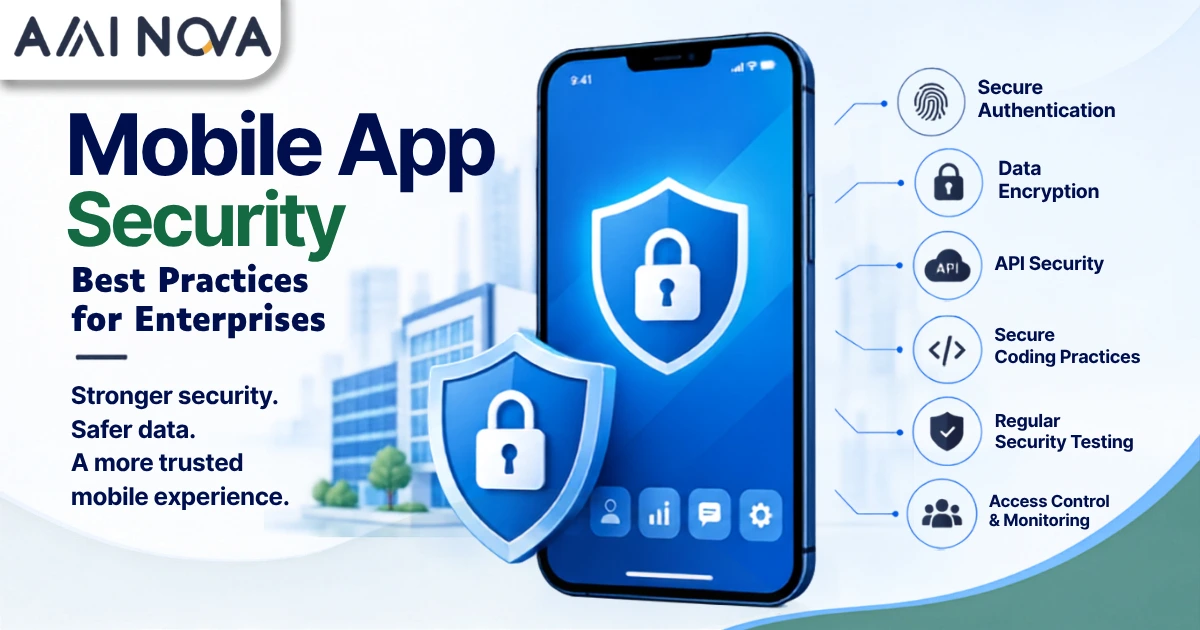
Explore mobile app security best practices for enterprises, including authentication, encryption, API security, testing, access control, and threat prevention.

Mobile apps have become a significant part of modern enterprises. From banking & healthcare to retail, logistics, education, and internal business requirements, organizations increasingly rely on mobile app solutions to connect employees, customers, partners, and business systems.
However, as the utilization of mobile apps grows, so does the security threat. Enterprise apps often handle sensitive customer information, payment details, employee data, business documents, authentication details, and confidential company data. A security weakness in a mobile app can therefore become much more than a technical issue; it can lead to financial losses, regulatory consequences, reputational damage, and loss of customer trust.
For enterprises building or adapting their mobile applications, security must be treated as an essential part of development rather than considered a secondary concern.
Why Mobile App Security Matters for Enterprises
An enterprise mobile app can deliver access to valuable business and customer data. If attackers exploit security weaknesses in the application, they may gain unauthorized access to accounts, databases, APIs, or internal systems.
The financial impact can be crucial. IBM's 2026 Cost of a Data Breach Report found that the average cost of a data breach in India reached INR 255 million (₹25.5 crore), increasing 15.9% from INR 220 million in 2025. The report also found that the average breach compromised approximately 39,500 records in India.
These numbers demonstrate why organizations should prioritize mobile app security.
1. Implement Secure Authentication
Authentication forms the first layer of security for enterprise mobile apps.
Organizations should avoid relying on passwords only. Strong authentication mechanisms such as multi-factor authentication (MFA), biometrics, device authentication, and secure session management can significantly improve account protection.
For applications containing sensitive business or financial data, enterprises should consider dynamic authentication. This allows the application to assess factors such as device, location, login behaviour, and risk before granting access.
Passwords should never be stored in plain text. Hash-based security and industry-standard authentication protocols should be used to protect the credentials.
2. Encrypt Sensitive Data
Enterprise mobile apps continuously transmit sensitive information between the application, APIs, and backend servers. Data should be encrypted both at rest and in transit.
HTTPS with modern TLS configurations which should be used for communication between the mobile app and backend systems. Sensitive information stored locally on the device should also be encrypted.
Developers should avoid saving passwords, authentication tokens, financial details, or confidential business data in insecure locations such as plain-text files, logs, or unprotected local storage.
Encryption enhance an additional layer of protection if a device is lost, stolen, or compromised.
3. Secure APIs and Backend Systems
A mobile app is only as secure as the systems it communicates with.
Enterprise applications commonly depend on APIs to fetch customer information, process transactions, authenticate users, and connect with business systems. Poorly secured APIs can therefore create a major attack surface.
Enterprises should implement:
Strong API authentication
Authorization checks
Input validation
Access controls
Importantly, authorization should be checked on the server rather than relying on the mobile app to determine whether a user has access to particular information.
4. Follow Secure Coding Practices
Security should be incorporated throughout the mobile app development lifecycle.
From planning and architecture to development, testing, and deployment, enterprises should evaluate security at every stage. For a detailed, stage-by-stage guide to planning and building enterprise-ready mobile applications, explore AaiNova’s Mobile Application Development: CTO’s Pointer-by-Pointer Checklist.
Regular code reviews can also help identify vulnerabilities before an application reaches production.
5. Conduct Regular Security Testing
Even a well-designed mobile app can develop vulnerabilities as its codebase, dependencies, APIs, and operating environments change.
Enterprises should therefore conduct regular:
Static application security testing (SAST)
Dynamic application security testing (DAST)
Dependency and library scanning
Mobile application security assessments
IBM's 2026 India findings highlight the value of proactive security. Offensive security testing, including red teaming and penetration testing, was identified as the largest cost-reducing factor in India, saving organizations an average of INR 24.7 million per breach.
6. Protect Against Phishing and Social Engineering
Technical security controls alone are not sufficient.
Phishing remains a major security concern for Indian organizations. According to IBM's 2026 report, phishing, including voice and SMS phishing, was the most common initial attack vector in India, accounting for 19% of incidents.
Enterprise mobile apps should therefore incorporate security features such as suspicious-login detection, device verification, session monitoring, and alerts for unusual account activity.
Employees should also receive regular cybersecurity awareness training, particularly when mobile apps are used for accessing corporate systems.
7. Use Secure Mobile App Storage
Mobile applications may store the entire data locally for performance, offline functionality, or user convenience.
However, sensitive information should not be stored unnecessarily. Enterprises should use secure storage mechanisms provided by mobile operating systems, such as Android Keystore and iOS Keychain, for credentials and cryptographic keys.
Developers should also deploy secure session expiration and remove sensitive information when it is no longer required.
8. Keep Third-Party Components Updated
Modern mobile app development often relies on open-source libraries, SDKs, APIs, analytics tools, payment gateways, and other third-party components.
While these technologies speed up development, they can also introduce security gaps. Organizations should maintain an inventory of third-party dependencies, monitor vulnerability disclosures, update outdated libraries, and remove components that are no longer required.
This is especially important because supply-chain risks continue to affect enterprises. IBM's 2025 report identified third-party vendor and supply-chain compromise as the second most common initial attack vector in India at 17%.
9. Implement Role-Based Access Control
Not every employee needs access to every feature or piece of information.
Role-Based Access Control (RBAC) allows organizations to assign permissions according to job responsibilities. For example, an employee may be allowed to view customer information but not export or modify it.
Enterprises should follow the principle of least privilege, giving users only the access they actually need.
Access permissions should also be reviewed regularly, especially when employees change roles or leave the organization.
10. Prepare an Incident Response Plan
No security strategy can guarantee that an attack will never happen.
Enterprises should therefore have a clear incident response plan explaining what happens when suspicious activity or a security breach is detected.
The plan should define:
Who is responsible for responding
How compromised accounts are disabled
How affected systems are isolated
How customers and employees are informed
How evidence is preserved
How systems are restored
How the organization prevents similar incidents
Fast detection and response can significantly reduce the impact of a security incident.
Mobile App Security Should Be Built Into Development
Enterprise mobile app security is not a single feature that can simply be added before launch. It is an ongoing process covering architecture, coding, authentication, APIs, data storage, testing, monitoring, and maintenance.
India's rapidly expanding smartphone ecosystem makes secure mobile experiences increasingly important. With 85.5% of Indian households having access to at least one smartphone, mobile applications are becoming an increasingly important digital channel for businesses.
At the same time, the rising cost of data breaches shows that security failures can have serious financial consequences. Organizations that integrate security into the mobile app development lifecycle can reduce vulnerabilities, protect sensitive information, and build greater customer confidence.
Build Secure Mobile Apps for Your Enterprise
Whether you are developing a customer-centric application, an employee mobility solution, or a complex enterprise platform, security should be considered from the architecture stage itself.
A reliable mobile app development partner can help enterprises implement secure authentication, encrypted data, protected APIs, secure coding practices, penetration testing, access controls, and continuous security monitoring.
Ready to build a scalable mobile app to improve mobile app security for your business? Connect with AaiNova to explore enterprise mobile app development solutions designed around your business and security requirements.
 by Anurag Sengupta