What should your first release include? Learn how UAE startups scope an MVP, what to cut, and what to plan for before development begins.
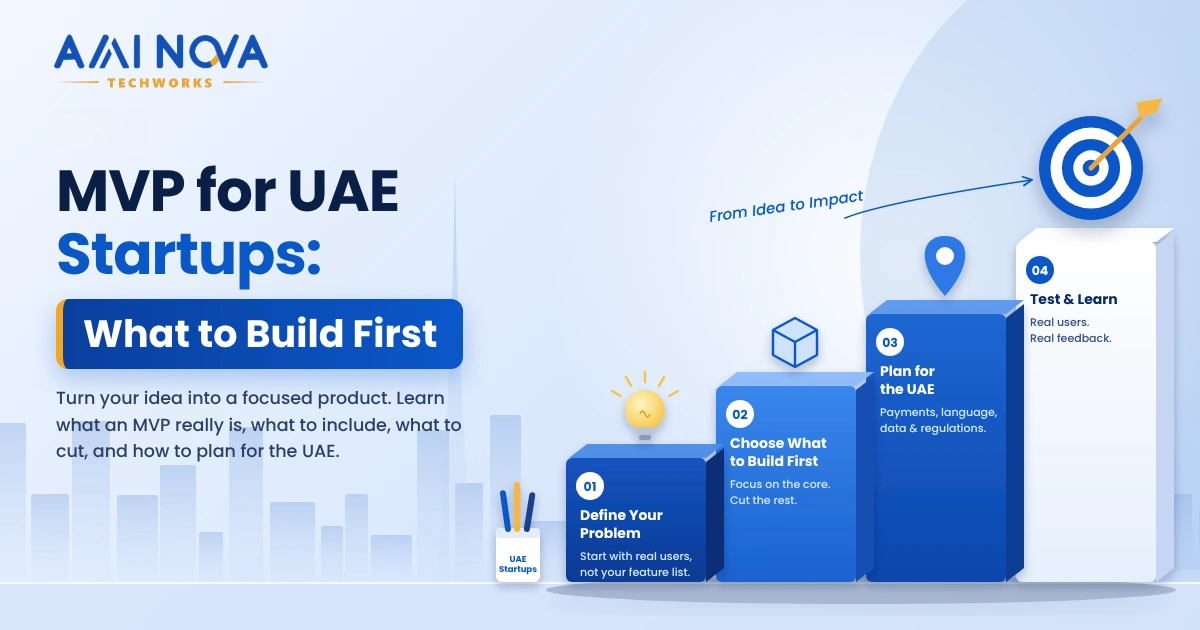
Most founders in Dubai and Abu Dhabi can list fifty app features before they can name one person who would pay for the product. That order of thinking is where startups lose months and money.
Analyses of founder post-mortems keep landing on the same finding: the most common reason startups fail is building something the market does not want, ahead of running out of cash. MVP development exists to catch that problem early, while it is still cheap to fix.
This guide explains what an MVP really is, how to decide what goes into the first release, what to cut, and what UAE startups should plan for from day one.
What an MVP Means, and What It Is Not
MVP stands for minimum viable product: the smallest working version of your idea that lets real users complete the one job it promises, so you can learn from what they actually do.
It is not a clickable prototype, which only shows how something might look. It is also not a stripped-down copy of your final vision with half the features broken. A good minimum viable product is small but complete. A user can sign up, do the one thing your product exists to do, and come back for more.
For a UAE startup, that single job might be booking a service, comparing quotes, tracking a delivery or paying an invoice. Pick one.
Start With the Problem, Not the Feature List
Before anyone writes code, write one sentence: who is the user, what problem do they have, and what outcome does your product deliver? If that sentence needs the word "and" three times, the scope is too wide.
Then speak to potential users. Ten to fifteen real conversations will teach you more than a month of internal debate. Ask how they solve the problem today, what it costs them in time or money, and what they have already tried.
Finally, decide how you will judge success before you build. A clear target, such as a set number of completed bookings in the first thirty days, keeps the team honest when opinions start competing.
How to Decide What to Build First
Sort every feature idea into three groups: must have, should have, and later. The must-have group holds only what a user needs to reach the outcome in your sentence. Everything else waits.
A few rules make the sorting easier:
• Build the core path first. Trace the shortest route from sign-up to value, and build only the screens on that route.
• Run the back office by hand. Approvals, reports and reconciliations can live in spreadsheets and WhatsApp for your first customers. Automate them once you know which ones hurt.
• Buy before you build. Login, payments, notifications and maps already exist as services, and using them saves weeks. Our guide to custom mobile apps versus ready-made apps explains where each approach makes sense.
• Defer the impressive extras. Multi-role dashboards, referral engines, advanced analytics and loyalty programmes belong in version two.
What a Full Product Looks Like, and What to Cut
It helps to see how much a mature platform contains. AaiNova's Walkies pet-service app serves five kinds of users: super admin, admin, franchise, pet walker and customer. It includes live GPS tracking, photo verification after each walk, a commission engine for franchise revenue splits and analytics dashboards, and it moved booking and payment fully online.
That is a complete platform for a business ready to scale. A startup testing a similar idea would not begin there. It would more sensibly start with one customer type and one flow, booking and paying for a service, and add the walker view, franchise tools and analytics once demand is proven. This is an example of how to scope, not a description of how Walkies was first launched.
UAE-Specific Points to Plan From Day One
Some choices are cheaper to make at the start than to retrofit later.
• Language. Decide whether you launch in English only or in English and Arabic. Arabic means right-to-left layouts, so it shapes the design from the first screen.
• Payments. Choose gateways that support the cards and wallets your UAE customers actually use, and confirm settlement terms before launch.
• Data protection. If you collect personal data, plan consent, storage location and access control early, and check the UAE data protection rules that apply to you, including any free-zone regime.
• Regulated sectors. Fintech, health and similar fields may need regulator approval before a public launch, so confirm this before you finalise scope.
• Support channel. WhatsApp is a common way to contact businesses in the UAE, so plan how those conversations will be handled.
Mistakes That Stretch an MVP
Most delays come from a few habits:
• Building for investors, not users. Features that only look good in a pitch deck are scope you can drop.
• Chasing every piece of feedback. Act on requests that several users make independently, and park the rest.
• Skipping measurement. If you cannot see who completes the core flow, you cannot learn from launch.
How to Know Your MVP Is Working
Return to the success target you set before building. Are enough users completing the core flow, coming back without reminders, and willing to pay or commit? If yes, expand one feature at a time. If not, change the problem or the way you solve it before adding anything. Either result is useful, and both cost far less than a full build.
What Does an MVP Cost in the UAE?
Agency pages in Dubai quote anything from under $ 1,360 (AED 5,000) for a very simple test to over $ 55,000 (AED 200,000) for a complex product, so a single average is not very useful. What matters is what drives the number: how many platforms you launch on (iOS, Android, web), how many user roles you support, how many integrations you need (payments, maps, WhatsApp, accounting), and how polished the design must be at launch.
Two habits keep the cost under control. Launch on one platform first, and cut every feature outside the core path. Then ask any partner for a scoped estimate after a short discovery phase, with the assumptions written down, rather than a number given on the first call.
Choosing a Partner for MVP Development
A good partner challenges your scope instead of simply accepting it. Look for a short discovery phase, working demos every one to two weeks, clear ownership of your source code, and an architecture that can grow if the MVP succeeds. Ask to see earlier products and how the scope was managed.
AaiNova's application development services cover mobile and web product development and ongoing maintenance.
Planning Your MVP in the UAE?
If you have an idea and want to know what belongs in the first release, talk to AaiNova's team. Share your idea and your target users, and we will help you define a focused first version that you can test with real customers.


 by Avantika Sonawane